
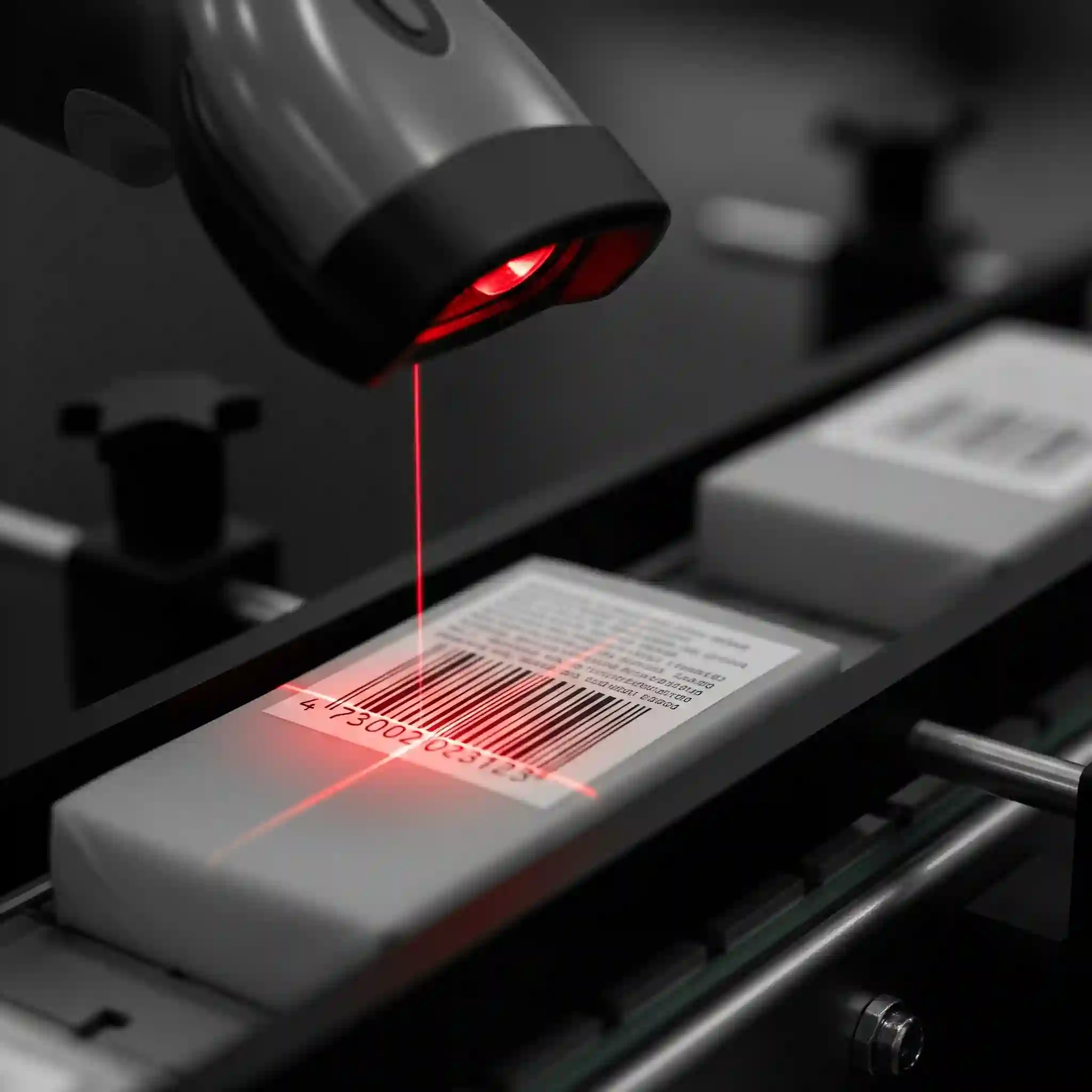
Identification, Verification and Automation Are Becoming One Connected Process
Over the last several editions of Traceability Weekly™, a pattern has been developing.
First, we looked at equipment becoming more connected.
Then came evidence of regulation and standards beginning to influence real-world product identification, including PPWR, QR/2D implementation and the wider direction of GS1 Sunrise 2027.
Last week, the distinction became clearer between simply giving a product an identity and building genuine traceability around that identity.
This week adds another layer.
Across coding and marking, pharmaceutical labelling, machine vision and RFID, identification is increasingly being designed together with verification, automation and data capture rather than as an isolated process.
The physical manufacturing journey remains:
Mark → Label → Verify → Inspect → Package
But underneath it sits an increasingly important digital journey:
Identify → Verify → Connect → Record → Act
That convergence is visible in several developments from the past week.
Videojet develops CIJ specifically around demanding pigmented-ink identification
Continuous inkjet remains one of the most established technologies in industrial product identification, but that does not mean the technology has stopped evolving.
Videojet introduced the 1880 C continuous inkjet printer this week, specifically targeting applications requiring reliable pigmented-ink coding. The announcement was published on 18 August.
Pigmented inks matter because conventional dye-based coding is not suitable for every substrate.
Products and components with dark surfaces, challenging colours or applications requiring greater code contrast can require pigmented inks to create identification that remains clearly visible.
That can include applications across automotive, extrusion, cables, electronics, building materials and other industrial manufacturing environments.
The wider significance is easily missed.
As traceability becomes more sophisticated, discussions naturally move towards QR, Data Matrix, RFID, serialisation and software.
But none of that removes one fundamental requirement:
the physical identifier still has to survive the production environment and remain readable.
A sophisticated traceability database has limited value if the mark connecting the physical product to that information is poor.
That is why the Mark stage remains fundamental to the complete traceability architecture.
HERMA combines robotic handling, labelling and camera verification
The pharmaceutical sector provides an even clearer demonstration of convergence.
HERMA has configured its 211R HC robotic labelling cell for a pharmaceutical customer application involving autoinjectors.
The system combines a Stäubli SCARA robot, Schunk gripping technology, product transport and rotation, a HERMA 500 label applicator and integrated camera monitoring.
The cell can label up to 15 products per minute, while its vision system monitors the labelling process, product position, orientation and applied markings. Products that do not conform can be detected and diverted automatically.
This is important because pharmaceutical identification cannot be separated easily from process assurance.
The requirement is not merely:
Did we apply a label?
It becomes:
Was the correct product presented?
Was it positioned correctly?
Was the label applied correctly?
Is the marking correct?
Can the result be verified?
What happens if it fails?
That transforms labelling from a mechanical operation into part of a controlled automated process.
HERMA’s use of robotics is also notable because the system targets high-mix, lower-volume pharmaceutical production where frequent product changes and difficult geometries can make conventional fixed automation harder to justify.
The principle is therefore not simply greater speed.
It is flexible, verified automation.
ENCLONY puts marking and inspection into the same pharmaceutical process
An even more literal combination of technologies comes from South Korea.
ENCLONY announced on 19 August that it is accelerating expansion across North America, Europe and Japan around its pharmaceutical machine-vision portfolio.
Its systems automatically inspect tablets and capsules for foreign material, breakage, discolouration, printing defects and other surface abnormalities.
But the particularly relevant development for product traceability is ENCLONY’s integration of UV laser marking and vision inspection within the same automated process.
Rather than marking being performed by one piece of equipment and inspection treated as a separate downstream activity, the architecture becomes:
Product → Laser Mark → Vision Verify → Inspect → Accept/Reject
ENCLONY’s PLANET LPI platform uses multiple 2D cameras, with 3D cameras available in one configuration, alongside UV laser marking. Its published specifications indicate tablet throughput reaching hundreds of thousands of units per hour depending on product geometry.
This matters particularly in pharmaceuticals.
As the industry has demonstrated through UDI, serialisation and wider track-and-trace requirements, a product identifier needs to be both correct and trustworthy.
The more identification becomes machine-readable, the stronger the argument becomes for machines to verify that information automatically rather than relying on human inspection.
That creates a natural convergence between two specialist markets:
coding & marking + machine vision
RFID moves product identity further downstream
Traceability does not end when a product leaves the manufacturing line.
Checkpoint Systems’ launch of Readfinity on 18 August provides an example of how product identity continues through the downstream supply chain.
The new RFID reader family combines high-speed item-level RFID reading with embedded processing and integration into POS, self-service and other retail infrastructure.
The important development is not simply faster RFID reading.
It is the continued movement towards environments in which individual physical products are digitally identifiable throughout their journey.
A product may begin with identification in manufacturing and subsequently interact with:
warehouse systems → logistics → inventory → retail → checkout → returns
RFID offers a different technology route from printed 2D codes, and the two should not be treated as interchangeable.
But both form part of the same broader direction.
Manufacturers, retailers and supply chains increasingly want the physical object to carry or connect to an identity that machines can recognise automatically.
That is the foundation on which richer traceability becomes possible.
Smart labels are becoming easier to manufacture
The RFID ecosystem is also evolving upstream.
Avery Dennison launched AD Fusion on 18 August, a programme designed to make RFID label production more accessible to label and packaging converters.
Its SmartFace technology provides materials with RFID inlays already inserted, reducing the need for converters to invest immediately in specialist inlay-insertion equipment.
This is a genuinely different development from the Digital Product Passport activity we covered previously.
The significance here is production accessibility.
If more converters can manufacture RFID-enabled labels without major additional capital expenditure, the available supply base for smart labels can widen.
And if the economics and availability of smart labels improve, more product categories become realistic candidates for item-level identification.
What connects these developments?
At first glance, a CIJ printer, robotic autoinjector labeller, tablet-inspection system and RFID reader belong to different markets.
Technically, they do.
Commercially, however, they are increasingly being pulled towards the same manufacturing objective:
creating a reliable digital relationship with the physical product.
Videojet addresses the reliability of the physical mark.
HERMA applies identification while controlling and verifying the product-handling process.
ENCLONY combines permanent marking with automated vision inspection.
Checkpoint carries item identity further downstream through RFID.
And Avery Dennison is reducing barriers to producing the smart labels that enable those RFID applications.
This is why defining the market simply as “coding and marking” or “packaging machinery” increasingly misses what is happening.
The boundaries are becoming less distinct.
Regulation will accelerate the convergence
Technology is not driving this transition alone.
Across different sectors, manufacturers are responding to an expanding landscape of regulation and standards around physical and digital product identity.
These include:
GS1 Sunrise 2027 and the transition towards 2D barcodes
EU UDI and medical-device identification
pharmaceutical serialisation and aggregation
PPWR and evolving packaging-information requirements
Digital Product Passports
tobacco track and trace
and product-specific traceability regimes that will continue to develop globally.
These frameworks differ substantially in their legal requirements and should not be grouped together as though they demand the same solution.
But they repeatedly create a similar engineering question:
How do we reliably connect this physical product with the correct information?
The answer can involve CIJ, TIJ, TTO, laser, DPM, print-and-apply labelling, machine vision, RFID, serialisation software, MES, ERP or combinations of several technologies.
That is why the market opportunity increasingly exists between the technologies, not only within them.
The talent requirement is changing with the technology
The same convergence has consequences for recruitment.
Historically, an OEM could build deep expertise around an individual technology.
That remains valuable.
But connected traceability increasingly requires people who can work across disciplines.
A Field Service Engineer may need to understand printers, cameras, PLC communication and industrial networks.
An Applications Engineer may need to understand substrates, code quality, GS1 data structures, verification and line integration.
A Project Engineer in pharmaceuticals may encounter robotics, labelling, vision, serialisation and validation within one installation.
A Technical Sales Manager increasingly needs to understand the business or compliance problem behind the equipment requirement, rather than simply the specifications of the machine being sold.
Manufacturers themselves may also need more internal specialists capable of connecting engineering, packaging, quality, IT and regulatory teams.
That is a much narrower talent market than generic industrial automation.
RoboEdge view
The story developing across Traceability Weekly™ is becoming increasingly consistent.
The industry is moving from:
putting information onto products
towards:
creating, applying, verifying, connecting and using product identity.
And that brings previously separate technologies into the same architecture:
Mark → Label → Verify → Inspect → Package
The next generation of traceability will not be defined by one printer, camera, RFID tag, robot or software platform.
It will be defined by how effectively those technologies connect the physical product, the production process and the data behind it.
For manufacturers, that means more capable production systems.
For OEMs and integrators, it creates opportunities to solve larger problems.
And for the talent market, it increases the value of the relatively small number of people who genuinely understand how these technologies work together.
Traceability Weekly™ is produced by RoboEdge Talent, covering the technologies, regulation and talent shaping global Product Identification, Traceability & End-of-Line Automation.
Hiring Or Building Capability In This Area?
RoboEdge maps specialist talent across OEMs, distributors, integrators and manufacturers in Product Identification, Traceability & End-of-Line Automation.